
Transparent China SEO Reporting: Track ROI & C …
Why transparent China SEO reporting matters
For international and local teams investing in China search channels, clear reporting does three things: it proves value, guides optimization, and reduces compliance risk. Stakeholders need to see how organic visits from Baidu, Sogou, and 360 convert into qualified leads and registrations so budgets align with real outcomes.
Unique tracking challenges in China
Tracking in China differs from western markets. Expect friction in these areas:
- Blocked global platforms. Google Tag Manager and some third‑party trackers may be partially unreliable from mainland IPs.
- WeChat and native apps. A large portion of journeys begin or complete inside WeChat or other apps where standard web cookies don’t apply.
- Payment and form flows. Checkout or KYC flows that use Chinese payment rails (WeChat Pay, Alipay) often redirect users or complete off‑site, complicating last‑click attribution.
- Latency and hosting. Mainland hosting and ICP filings affect page load and crawl behaviour, which in turn affects measured engagement.
Recommended tools and integrations
Use a hybrid stack combining local Chinese tools and global analytics adapted for China.
- Baidu Zhanzhang (Baidu Webmaster Tools) — monitor indexing, search queries, and crawl data directly from Baidu.
- 360 & Sogou Webmaster Tools — submit sitemaps and monitor crawl/indexing behaviour for those engines.
- Server-side analytics / CDP. Use server logs and a Customer Data Platform to capture events reliably, especially for app/WeChat flows.
- Local analytics providers. Consider Tencent Analytics or similar China-friendly analytics that handle WeChat referrals better than some global tools.
- Tag management with server-side fallbacks. If using GTM or similar, deploy server-side tagging to avoid client-side blocking and to centralize sensitive data handling.
- Attribution and BI tools. Integrate with Looker, Tableau, or local BI stacks to unify data from Baidu, CRM systems, and payment platforms.
- Utm.io or internal UTM standardizer. Enforce consistent campaign tagging for all content and PR placed on Chinese portals and WeChat pushes.
Tracking setup: events, UTM and server-side
Reliable reporting relies on event-level tracking and persistent identifiers across touchpoints.
Event taxonomy
- Define events for: organic landing, page view, form start, form complete (registration), KYC start, payment complete, WeChat share, click-to-call.
- Use consistent event names in Chinese and English where teams require bilingual reporting.
UTM strategy
- Standardize UTMs for editorial, WeChat pushes, Baidu paid (if any), portal PR, and partner referrals. Example: utm_source=weixin, utm_medium=article, utm_campaign=2026-q3-pillar.
- Shorten and preserve UTMs through intermediate redirects and payment gateways; server-side UTM capture can persist identifiers through offline redirects.
Server-side tracking
- Implement server-side event ingestion for critical conversion events (registrations, payments). This reduces loss from blocked scripts and cross-domain issues.
- Use hashed user identifiers (email/phone hashed) to stitch sessions between web, app, and CRM while protecting privacy.
Attribution for registrations and revenue
Attribution should reflect how users find you, especially when journeys cross apps and payment rails.
- Multi-touch models. Report first touch, last touch, and a weighted multi-touch model so stakeholders see different views of performance.
- WeChat-specific paths. Tag WeChat pushes and landing pages; capture official account IDs and campaign IDs server-side to attribute registrations that begin in WeChat.
- Offline attribution. For phone or branch signups, use trackable phone numbers, QR codes, or unique promo codes to link back to the originating channel.
KPIs and dashboard design
Design dashboards that are simple, credible, and actionable for decision-makers.
Core KPIs
- Organic visits by engine — Baidu, Sogou, 360 split.
- Qualified registrations — registrations that pass KYC or meet lead scoring thresholds.
- Cost per acquisition (if running campaigns) — combine SEO-driven operational costs to model organic CAC.
- Revenue or LTV from organic cohorts — measure cohorts by registration month and channel.
- Indexing & visibility metrics — impressions, clicks, and average position from Baidu Zhanzhang and other webmaster tools.
Dashboard structure
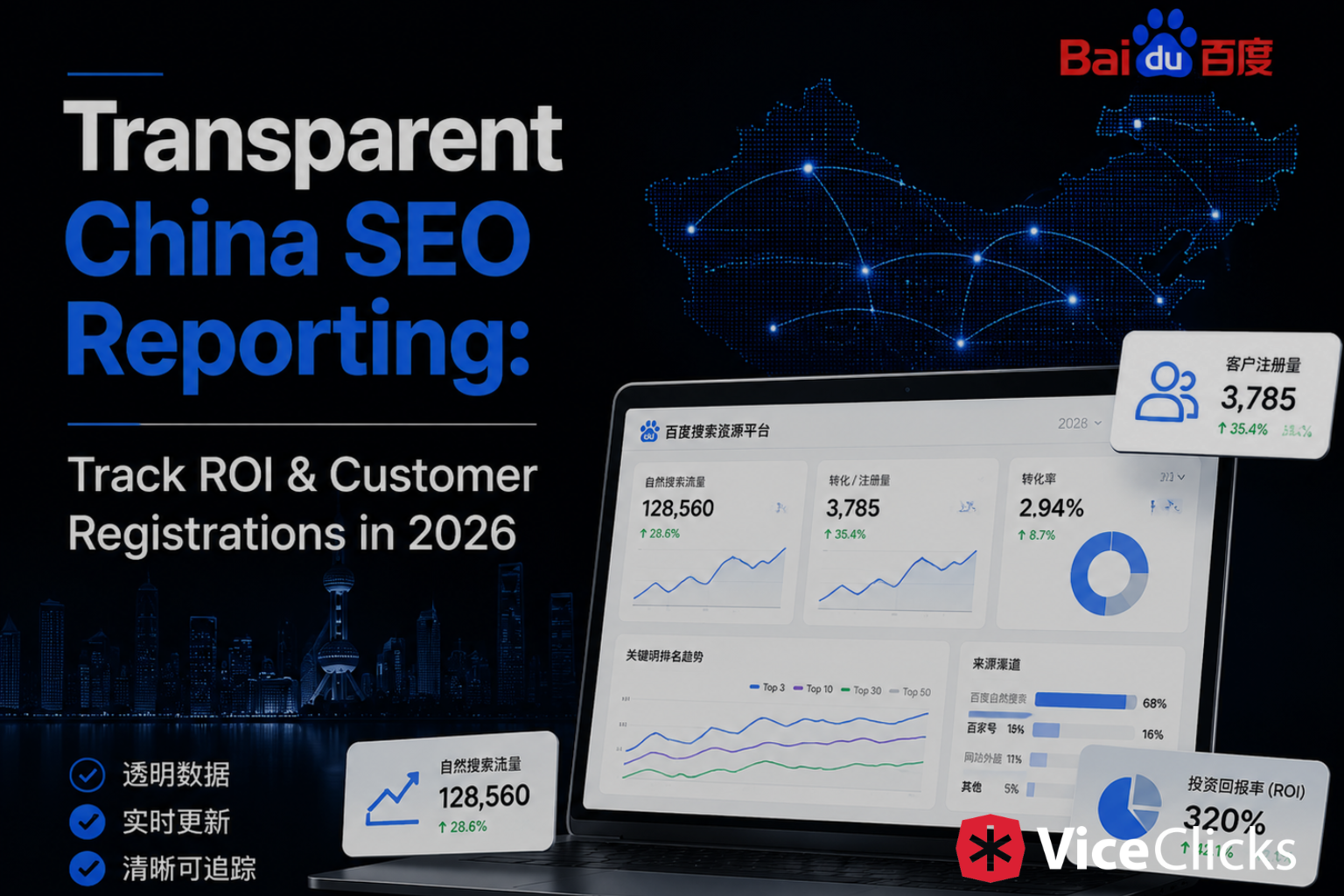
- Top row: high-level outcomes (registrations, conversion rate, LTV, CAC estimate).
- Second row: engine-level performance and trends (Baidu vs Sogou vs 360).
- Third row: channel attribution breakdown and WeChat-specific metrics.
- Bottom row: data quality indicators (sitemap status, server-side event counts vs client-side counts, UTM mismatch rate).
Data validation and governance
Reliable reports require ongoing data validation and clear governance.
- Daily reconciliation. Compare server event counts to analytics counts and Baidu Zhanzhang impressions to catch drops quickly.
- Automated anomaly alerts. Set thresholds for sudden drops in Baidu impressions or registration conversions and trigger investigations.
- Privacy and retention policies. Ensure hashed identifiers and event storage comply with Chinese data rules; delete or anonymize data according to retention policy.
- Ownership and documentation. Maintain a tracking plan and assign an owner for each event and UTM parameter.
90‑day implementation plan
- Week 1–2: Audit current tracking — verify Baidu/Sogou/360 submissions, server logs, existing tags, and UTM usage. Document gaps.
- Week 3–4: Create event taxonomy, implement server-side event ingestion for registration and payment endpoints, and enforce UTM conventions.
- Month 2: Integrate Baidu Zhanzhang and Sogou/360 webmaster data into BI; build initial dashboard with key KPIs and data‑quality checks.
- Month 3: Validate attribution models (first, last, multi-touch), configure anomaly alerts, and pilot cohort LTV reporting for organic registrations. Iterate on dashboard based on stakeholder feedback.
Resources
- Baidu Zhanzhang (Baidu Webmaster Tools) — official indexing and query data from Baidu.
- China SEO Service (Internal link) — professional support for China SEO strategy and implementation.
- MDN Web Docs — Performance — improve page speed and user experience, which supports conversion and crawlability.