
From Clicks to Customers: Measure ROI with Profess …
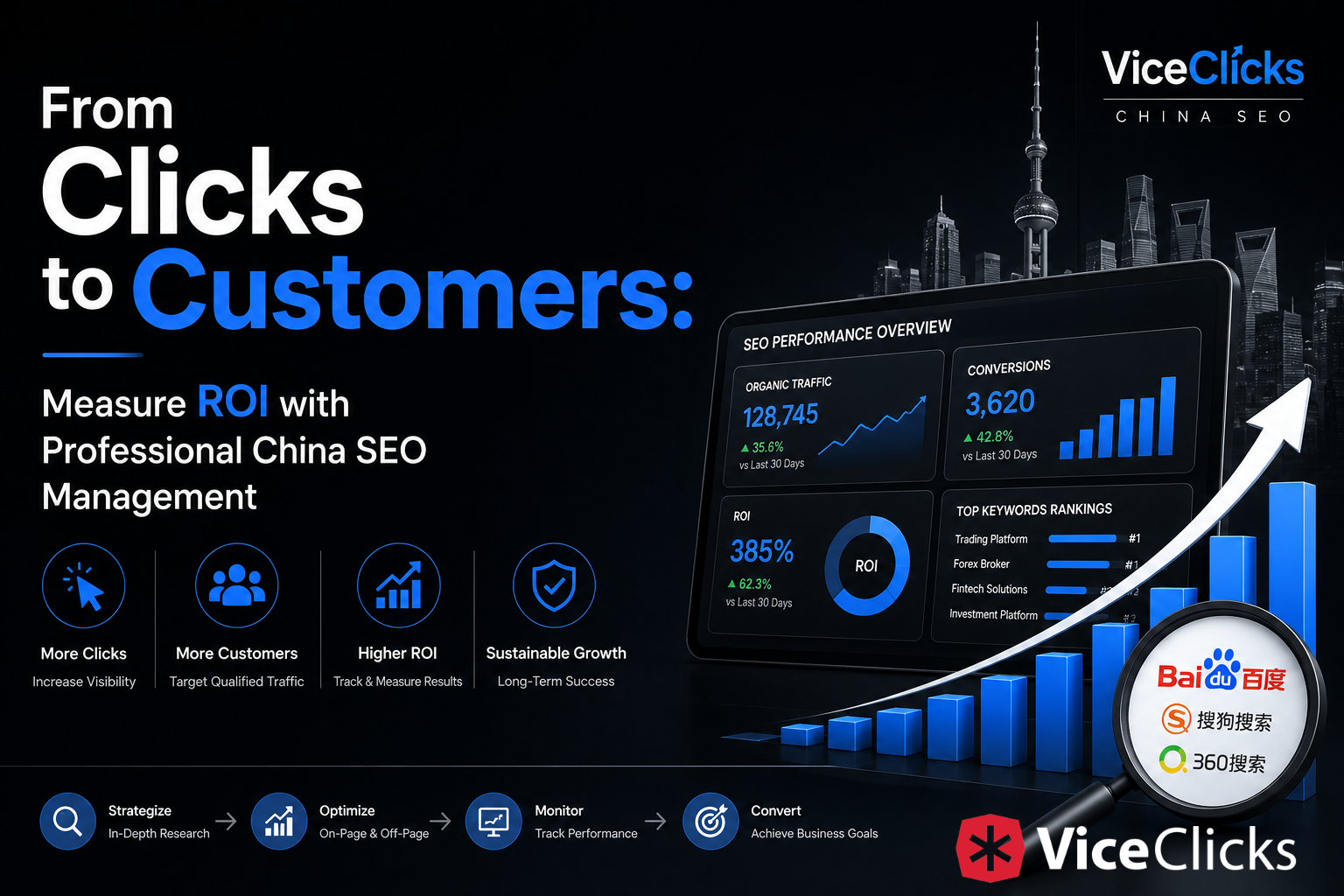
Summary: Many brands treat China SEO as a traffic channel and stop there. Professional China SEO management goes further, connecting search visibility on Baidu, Sogou and 360 to registrations, deposits, sales and long‑term customer value. This guide explains how to track the full journey from clicks to customers, which metrics and tools matter in China, how to build transparent reporting, and why a specialist team or agency can help you prove real ROI instead of just counting visits.
- Why ROI measurement matters for China SEO
- Unique measurement challenges in China
- Data foundation: events, tracking and segmentation
- Journey mapping: from impression to customer
- Key KPIs for professional China SEO management
- Dashboards and reporting stakeholders actually use
- The role of a professional China SEO team
- 90‑day plan to move from clicks to customers
- Resources
Why ROI measurement matters for China SEO
In 2026, competition for Chinese search users is intense. Brands in finance, trading, SaaS, ecommerce and gaming all invest in Baidu, Sogou and 360, but only those who track ROI can defend budgets and scale what works. Counting clicks alone is not enough; decision‑makers want to know how many customers and how much revenue their China SEO brings, and how it compares with paid search, affiliates or social.
Professional China SEO management turns search into a predictable growth engine by tying every optimization and campaign to measurable outcomes like registrations, orders or funded accounts.
Unique measurement challenges in China
Measuring ROI from China SEO involves hurdles that many global teams underestimate. These challenges make it harder to connect Baidu and other engines to conversions if you use only standard western analytics setups.
China‑specific obstacles
- Fragmented user journeys. Chinese users often move between browsers, WeChat, apps and payment gateways, breaking conventional cookie‑based tracking.
- Different search engines. Baidu, Sogou and 360 each report data differently, and not all integrate neatly into global tools out of the box.
- Regulatory and hosting constraints. Data localization rules and China‑specific hosting setups may limit where and how you collect and process analytics data.
- Blocked or throttled scripts. Some analytics scripts load slowly or inconsistently from mainland IPs, leading to gaps in reported events and sessions.
Data foundation: events, tracking and segmentation
To move from clicks to customers, you need a strong data foundation. That means defining events, setting up robust tracking and segmenting traffic correctly so you know which engine and content actually drives results.
Define meaningful events
- Micro‑conversions. Track actions such as newsletter sign‑ups, ebook downloads, demo requests or WeChat follows that show user intent before a full conversion.
- Primary conversions. Record core business events like account registrations, KYC completion, first deposits, purchases or trial activations.
- Retention signals. For subscription or trading businesses, log repeat logins, additional deposits and renewals as part of the ROI picture.
Set up reliable tracking
- Event tracking across web and app. Implement event tags or server‑side tracking for both websites and apps, so SEO wins that drive app installs are fully counted.
- China‑friendly analytics tools. Choose analytics and tag management solutions that load quickly and consistently for mainland users.
- Engine and source segmentation. Ensure all organic traffic from Baidu, Sogou and 360 is properly labelled in analytics, not lumped into one “search” bucket.
Journey mapping: from impression to customer
Once the foundation is in place, professional China SEO management maps user journeys from first impression to final conversion. This lets you attribute ROI to the right queries, pages and campaigns.
Understand the full funnel
- Impressions and clicks. Start with how often your pages are shown and clicked for key queries on Baidu and other engines.
- Landing‑page behaviour. Analyze bounce rates, time on page, scroll depth and click paths to see which content actually persuades users to take the next step.
- Multi‑step conversion paths. Chart typical sequences like “Baidu → landing page → WeChat follow → app install → registration → deposit” to see where users drop off.
Attribute value to SEO touchpoints
- First‑touch attribution. Measure how often SEO is the first channel in a journey that ends in a conversion.
- Assisted conversions. Track conversions where SEO contributed one or more touchpoints but wasn’t the final click.
- Last‑touch attribution. Analyze conversions where Baidu or another Chinese engine was the last click before the conversion event.
Key KPIs for professional China SEO management
Professional China SEO management focuses on KPIs that link search activity to business outcomes. These metrics help you distinguish vanity wins from real performance.
Performance metrics beyond traffic
- Qualified leads or registrations. Count only leads or sign‑ups that meet basic quality criteria, such as verified contact details or completed forms.
- Conversion rate by engine. Compare how visitors from Baidu, Sogou and 360 convert, so you can prioritize which engine to optimise further.
- Cost per acquisition (CPA). Combine SEO costs (people, content, tools) with conversion numbers to estimate CPA for China SEO versus paid channels.
- Customer lifetime value (LTV). Track how much revenue SEO‑acquired customers generate over time compared with other sources.
Visibility and engagement KPIs
- Organic impressions and click‑through rate. Monitor how often pages appear in Chinese SERPs and how often users click them.
- Keyword rankings for strategic terms. Focus on positions for high‑intent queries related to your core products and brand, not just generic traffic terms.
- Engagement on key pages. Measure performance for pillar content, landing pages and educational resources that drive conversions later in the journey.
Dashboards and reporting stakeholders actually use
Good data means little if stakeholders can’t understand it. Professional China SEO management delivers dashboards and reports that clearly show how clicks become customers.
Designing useful dashboards
- Business‑first layout. Put registrations, deposits, revenue and LTV at the top, with supporting traffic and ranking metrics below.
- Engine and campaign breakdowns. Show performance by Baidu, Sogou and 360, and by key content campaigns or product themes.
- Trend lines and cohorts. Visualise changes over time and cohort performance to highlight the compounding effect of SEO on customer value.
Reporting cadence and narratives
- Monthly performance reviews. Provide regular reports that explain what changed, why, and what action is planned next.
- Campaign retrospectives. After major content or PR pushes, summarise their impact on visibility, leads and revenue to refine future investments.
- Clear stories for leadership. Translate metrics into simple narratives, such as “This quarter, Baidu SEO delivered X new customers at Y CPA and Z projected LTV.”
The role of a professional China SEO team
Building this kind of measurement and optimisation framework in‑house takes time and specialised knowledge of Chinese search behaviour, analytics quirks and local regulations. Many brands choose to work with professionals who already manage China SEO at scale.
What professional China SEO management adds
- Local expertise. Specialists understand Baidu’s ranking patterns, Sogou’s social signals and 360’s security focus, and can interpret data correctly.
- End‑to‑end implementation. A professional team sets up tracking, defines events, builds content, manages PR and reports on ROI in a coherent way.
- Continuous optimisation. Rather than one‑off audits, professional management means ongoing adjustments based on new data and algorithm changes.
When to consider external support
- Complex industries. Finance, trading, SaaS and regulated sectors benefit from experienced partners who know both SEO and compliance realities.
- Limited internal bandwidth. If your team is stretched thin, delegating China SEO management prevents missed opportunities and reporting gaps.
- Need for transparent ROI. When leadership demands clear numbers before scaling China investment, professional reporting can accelerate decision‑making.
90‑day plan to move from clicks to customers
Here is a practical roadmap to evolve your China SEO from traffic‑only to ROI‑driven within about three months.
- Weeks 1–2: Audit and event design. Review current analytics, identify missing events, clean up engine segmentation and define primary and secondary conversion events across web, app and WeChat touchpoints.
- Weeks 3–4: Tracking implementation. Deploy event tracking for registrations, deposits, purchases and key micro‑conversions; ensure data for Baidu, Sogou and 360 organic sessions is complete and reliable.
- Month 2: Journey and KPI mapping. Build basic funnels showing how users move from search to conversion, set target KPIs for each stage and engine, and align content and SEO initiatives with those goals.
- Month 3: Dashboards and optimisation. Launch dashboards for leadership, run optimisation tests on high‑traffic pages, and start linking new SEO campaigns directly to ROI metrics in regular reports.
Resources
- ViceClicks China SEO Service — professional China SEO management tailored to finance, forex, trading and online businesses that need measurable growth from Baidu, Sogou and 360.
- MDN Web Docs — Performance — a high‑authority technical resource for improving site speed and user experience, which supports better conversion from organic traffic.
Closing thoughts
Clicks are easy to get; customers are harder. When you treat China SEO as a measurable acquisition engine instead of just a visibility play, you can justify investment, prioritise the right queries and pages, and build a repeatable growth system for Baidu, Sogou and 360. Professional China SEO management makes that shift possible by connecting the dots between impressions, behaviour and revenue, so every optimisation moves you closer to real business outcomes.