
How to Choose the Right China SEO Service Provider …
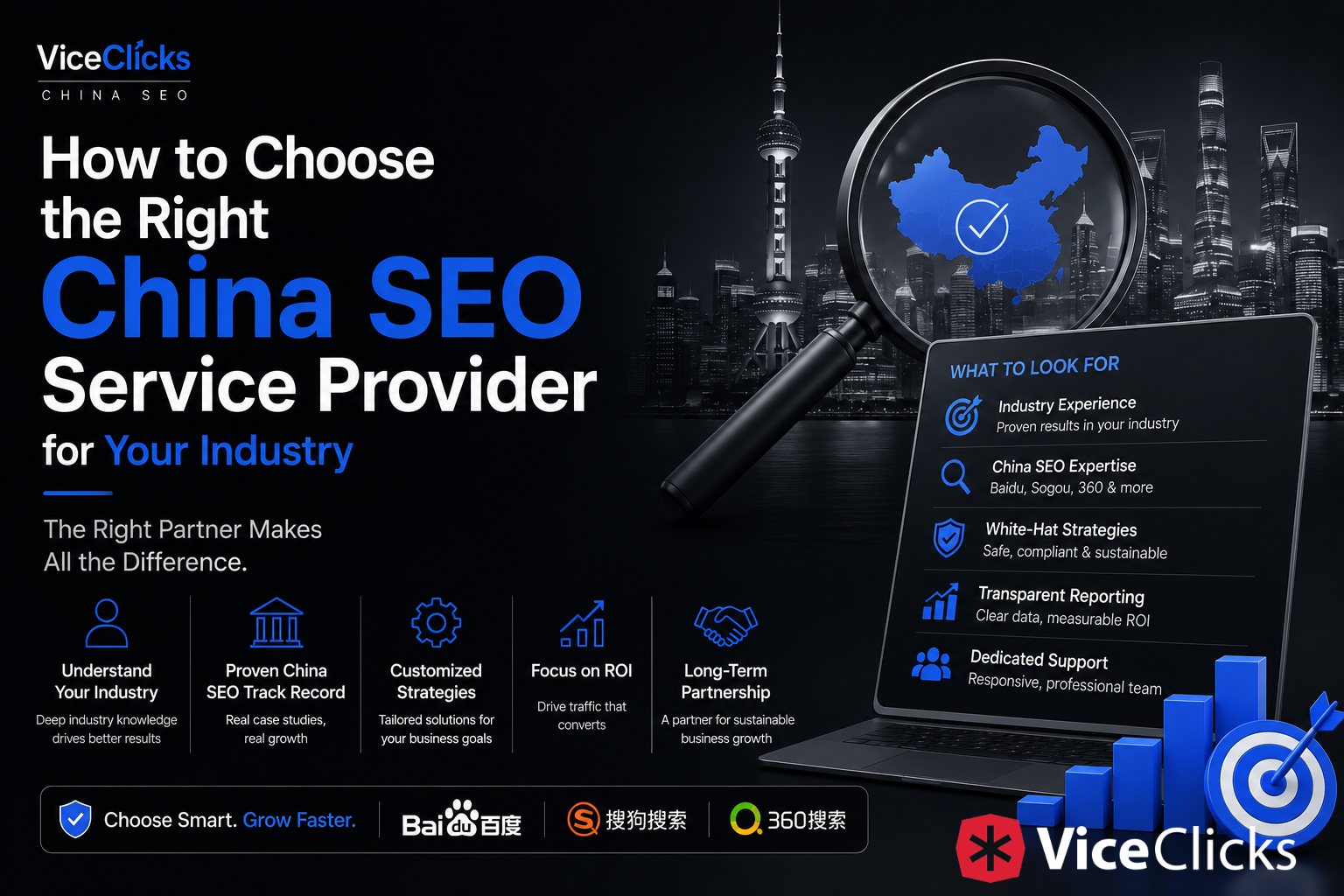
Summary: Choosing the right China SEO service provider in 2026 can make the difference between limited visibility and sustainable growth on Baidu, Sogou and 360. This guide walks you through the key criteria: platform expertise, technical capabilities, industry understanding, content and link quality, compliance, reporting and pricing structure. By following a structured evaluation checklist, you can select a partner that fits your industry, risk profile and growth goals instead of relying on vague promises or generic case studies.
- Why your China SEO provider choice matters
- Step 1: Define your industry needs and goals
- Step 2: Check platform and technical expertise
- Step 3: Assess industry fit and case studies
- Step 4: Evaluate content, link building and localization
- Step 5: Review compliance, risk and transparency
- Step 6: Understand reporting, communication and pricing
- Step 7: Build a shortlist and run a pilot
- Resources
Why your China SEO provider choice matters
China SEO is not just “more of the same” global SEO. Search engines, regulations, language nuances and user behaviour all differ, and mistakes can be expensive—especially for regulated industries like finance, trading or healthcare. A suitable China SEO service provider brings both technical and cultural understanding, helping you avoid compliance pitfalls and build long‑term visibility instead of chasing short‑term hacks.
Choosing badly may mean generic strategies, poor localization, risky link schemes or opaque reporting. Choosing well gives you a partner who treats China SEO as a business channel, not just a rankings game.
Step 1: Define your industry needs and goals
Before evaluating providers, clarify what “success” looks like for your business. Different industries and business models require different China SEO approaches, timelines and risk tolerance.
Clarify objectives and constraints
- Business outcomes. Decide whether your priority is brand visibility, qualified leads, account registrations, ecommerce transactions or another measurable KPI.
- Industry specifics. Finance, forex, trading, SaaS, gaming, ecommerce and B2B all have unique regulatory, content and funnel requirements.
- Risk profile. Know your tolerance for experimentation versus conservative, compliance‑first strategies; this shapes which provider model fits you best.
Define scope and internal capacity
- Scope of work. Decide whether you need a full‑service China SEO partner (technical, content, links, analytics) or only specific components.
- Internal resources. Evaluate your team’s ability to support content creation, approvals and technical work; some providers expect more client involvement than others.
Step 2: Check platform and technical expertise
A strong China SEO provider must be fluent in Baidu, Sogou and 360, not just Google. They should understand local webmaster tools, hosting realities, ICP requirements and mobile performance expectations.
Questions to ask about platform expertise
- Which Chinese engines do you actively optimise for? Look for proven experience with Baidu, Sogou and 360, including examples of engine‑specific strategies.
- How do you use local webmaster tools? Ask how they work with Baidu’s site management tools and equivalents for Sogou and 360 to track indexing, errors and coverage.
- What is your approach to hosting and ICP? They should be able to explain practical options for mainland hosting, Hong Kong setups and China‑friendly CDNs, along with ICP implications.
Technical SEO capabilities
- Performance and mobile. Confirm they routinely audit and improve site speed, mobile UX and renderability for mainland users.
- Structure and crawlability. Ensure they can handle sitemaps, robots.txt, redirects, canonicalization and language tags for Chinese content.
- Analytics and tracking. Ask how they deal with tracking limitations in China and how they integrate data from different engines into coherent reporting.
Step 3: Assess industry fit and case studies
China SEO is more effective when the provider understands the specifics of your industry: terminology, user intent, regulations and typical customer journeys. Look for evidence of successful work in businesses similar to yours.
Evaluate experience in your vertical
- Relevant case studies. Request examples from your industry, with clear metrics (traffic, leads, revenue, registrations) and a timeline.
- Understanding of your funnel. Ask them to describe a typical customer journey in your sector and where China SEO plays a role; vague answers may signal limited experience.
- Team background. Check if they have strategists or account managers who have previously worked with finance, trading, SaaS, gaming or ecommerce brands.
Check references and reputation
- Client references. Speak with existing or past clients in similar industries to confirm performance and reliability.
- Public reputation. Search for independent reviews or rankings that mention their strengths (technical SEO, localization, compliance, reporting) for China markets.
Step 4: Evaluate content, link building and localization
Content and links are central to China SEO, but the way they are executed matters. You want a provider who prioritises high‑quality Chinese content, natural link acquisition and brand‑safe outreach.
Content creation and localization
- Native Chinese copywriting. Confirm that content is written or edited by native speakers with experience in marketing and your industry.
- Localization vs translation. Ask how they adapt global concepts, offers and case studies for Chinese audiences; you want genuine localization, not direct translation.
- Keyword strategy. Ensure they use robust Chinese keyword research and maintain natural keyword density (for example, in the 1.5%–2.5% range for primary phrases) instead of stuffing.
Link building and authority
- Link acquisition methods. Ask where and how they secure backlinks—prioritize editorial coverage, partnerships, Q&A platforms and niche sites instead of anonymous link farms.
- Quality control. Check if they manually review domains and track backlog of links to avoid low‑value or risky sources.
- Platform presence. Explore how they use platforms like WeChat, Zhihu or local communities to support link and trust building, not just direct SERP manipulation.
Step 5: Review compliance, risk and transparency
For regulated industries—finance, forex, healthcare, education—compliance is non‑negotiable. Even for less regulated sectors, brand safety matters. The right China SEO service provider will be open about risk and use transparent, white‑hat tactics.
Compliance practices
- Regulatory awareness. Ask how they handle content for regulated topics and what internal checks they use to avoid misleading or non‑compliant claims.
- User data and privacy. Check their approach to tracking and data storage, especially when dealing with sensitive user information.
- Content moderation. Clarify how they manage user‑generated content, comments and reviews that could impact compliance or brand reputation.
Risk and transparency
- Forbidden tactics. Ask explicitly which tactics they refuse to use (e.g., bulk link schemes, cloaking, hidden text). Clear boundaries are a good sign.
- Change management. Understand how they respond to algorithm updates or policy changes; you want a provider who adapts solutions rather than blames circumstances.
- Contract clarity. Ensure the contract explains deliverables, timelines, responsibilities and exit clauses in straightforward language.
Step 6: Understand reporting, communication and pricing
Good China SEO providers know that international clients need transparency and predictable communication. Reporting quality often reveals how mature their operations are.
Reporting and communication
- Regular reporting cadence. Ask how often you’ll receive performance reports and what they include (traffic, rankings, conversions, revenue, actions taken).
- Custom dashboards. Check whether they can integrate data from Baidu, Sogou, 360 and your analytics into simple dashboards that your team can understand.
- Strategic reviews. Clarify how often you will have strategic reviews to adjust goals, budgets and focus areas based on data.
Pricing and value
- Transparent fee structure. Understand how they charge (retainer, project, performance‑linked) and what is included versus billed separately.
- Investment vs outcomes. Ask how they frame expected outcomes over three to six months so you can compare value against other channels.
- Scalability. Check whether their model scales with you—can they support more markets, products or content volume as results grow?
Step 7: Build a shortlist and run a pilot
Once you’ve gathered information on several providers, narrow down to a shortlist and test with a structured pilot project. This gives you real‑world evidence of fit before committing long‑term.
Shortlist and comparison
- Create a comparison matrix. List providers and score them on platform expertise, industry fit, content quality, link strategy, compliance, reporting and pricing.
- Weight criteria by importance. Give more weight to categories that matter most for your industry (e.g., compliance for finance, content for gaming or ecommerce).
Pilot engagement
- Define a clear pilot scope. Choose a limited set of pages, keywords or campaigns with clear success metrics (traffic, leads, registrations, revenue).
- Evaluate process and results. Observe communication, implementation quality and early performance; these often predict long‑term experience.
- Decide based on evidence. Use pilot data and qualitative impressions—not just sales pitches—to finalize your China SEO service provider choice.
Resources
- ViceClicks China SEO Service — a specialized China SEO service provider focused on finance, forex, trading, gaming and online businesses seeking measurable growth on Baidu, Sogou and 360.
- MDN Web Docs — Performance — a high‑authority resource for improving site speed and user experience, which supports better SEO results in every market, including China.
Closing thoughts
Choosing the right China SEO service provider is a strategic decision, not a quick purchase. When you define your needs, test for platform and industry expertise, insist on high‑quality localization and white‑hat link building, and demand transparent reporting, you dramatically increase the odds of finding a partner who can drive sustainable growth in China. Use this framework as a checklist during evaluations, and you’ll be better positioned to select a provider that fits your industry, culture and long‑term ambitions.