
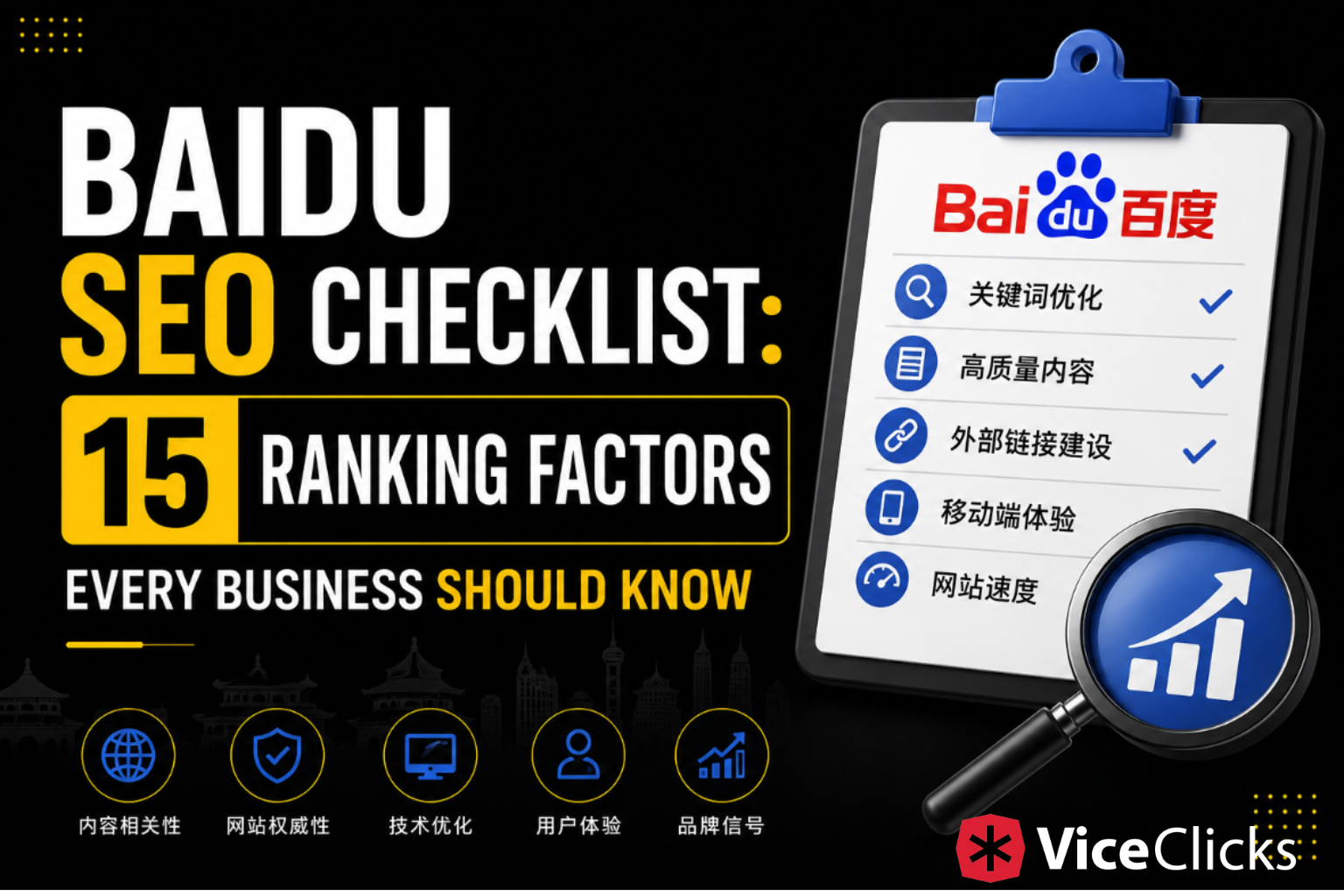
Baidu SEO Checklist: 15 Ranking Factors Every Busi …
For companies looking to enter the Chinese market, ranking well on Baidu can be the difference between generating qualified leads and remaining invisible to potential customers.
Many businesses assume that strategies that work for Google will automatically work for Baidu. While both search engines aim to deliver relevant results, Baidu has its own ranking signals, technical requirements, and user behavior patterns that marketers must understand.
Whether you’re launching a new website in China or improving your existing digital presence, this Baidu SEO checklist covers 15 important ranking factors every business should know.
Why Baidu SEO Is Different from Google SEO
Baidu remains one of China’s most influential search engines and serves hundreds of millions of users searching for products, services, and information daily.
Unlike Google, Baidu operates within China’s unique internet ecosystem, meaning businesses must consider factors such as:
- Chinese-language content
- Local hosting requirements
- ICP registration
- Chinese user behavior
- Local backlinks
- Platform integrations
A successful Baidu SEO strategy requires localization rather than simple translation.
1. Use Simplified Chinese Content
Content language is one of the most important ranking factors.
Baidu primarily serves users searching in Simplified Chinese. While English content may still be indexed, Chinese-language pages generally perform significantly better.
Businesses should:
- Create native Chinese content
- Localize marketing messages
- Use Chinese keyword research
- Adapt content to local culture
Translation alone is often insufficient for competitive rankings.
2. Obtain an ICP License
ICP (Internet Content Provider) registration is highly recommended for businesses targeting mainland Chinese audiences.
An ICP license helps:
- Improve website credibility
- Enable mainland hosting
- Build user trust
- Enhance website accessibility
Many successful China-focused websites maintain proper ICP registration as part of their SEO strategy.
3. Improve Website Loading Speed
Website speed directly affects user experience and search performance.
Chinese users expect fast-loading websites.
To improve performance:
- Use China-based hosting
- Implement CDN solutions
- Compress images
- Minimize unnecessary scripts
A faster website can lead to better engagement and improved rankings.
4. Use a .CN Domain When Appropriate
Although not mandatory, a .cn domain can help strengthen local relevance.
Chinese users often perceive .cn websites as more trustworthy and locally focused.
Examples include:
- yourcompany.cn
- brandname.com.cn
For businesses targeting China exclusively, local domains may provide additional advantages.
5. Optimize Meta Titles and Descriptions
Baidu continues to place strong importance on traditional SEO elements.
Every page should include:
- Optimized title tags
- Relevant meta descriptions
- Target keywords
- Clear page structure
Well-written metadata can improve click-through rates from search results.
6. Conduct Chinese Keyword Research
Direct translation of English keywords rarely works.
Chinese consumers often use different search phrases and terminology.
Keyword research should focus on:
- Local search intent
- Industry-specific terms
- Consumer language
- Long-tail keywords
Understanding how Chinese users search is essential for effective optimization.
7. Create High-Quality Localized Content
Content remains one of Baidu’s strongest ranking signals.
Businesses should publish:
- Industry guides
- Educational articles
- Case studies
- Local market insights
- Frequently asked questions
Consistent content creation helps improve authority and visibility.
8. Build Local Chinese Backlinks
Backlinks continue to play an important role in Baidu SEO.
However, local relevance often matters more than international authority.
Good backlink sources include:
- Chinese business directories
- Industry websites
- Local news portals
- Chinese blogs
- Partner websites
Quality and relevance should always take priority over quantity.
9. Optimize Mobile Experience
China is one of the world’s most mobile-driven markets.
Many users access websites exclusively through smartphones.
Ensure your website:
- Loads quickly on mobile
- Uses responsive design
- Provides easy navigation
- Delivers a seamless user experience
Mobile optimization is no longer optional.
10. Improve Internal Linking Structure
Strong internal linking helps Baidu understand website structure.
A well-organized website should:
- Connect related pages
- Support content discovery
- Distribute authority effectively
- Improve user navigation
Logical internal linking can positively influence rankings.
11. Use Clear URL Structures
Simple URLs improve both user experience and crawlability.
Examples:
Good:
yourwebsite.com/baidu-seo-guide
Less Ideal:
yourwebsite.com/page?id=12345&ref=abc
Clean URLs help search engines understand page relevance more efficiently.
12. Regularly Update Website Content
Fresh content signals activity and relevance.
Businesses should:
- Update existing articles
- Publish new content
- Refresh outdated information
- Add recent industry developments
Regular updates help maintain search visibility over time.
13. Optimize Images Properly
Baidu cannot fully understand images without supporting information.
Image optimization should include:
- Descriptive file names
- Alt text
- Appropriate file sizes
- Fast-loading formats
Proper image optimization contributes to better overall SEO performance.
14. Strengthen Brand Signals
Baidu increasingly values trusted brands.
Businesses can improve brand authority by:
- Building media coverage
- Increasing online mentions
- Maintaining active social profiles
- Publishing authoritative content
Strong brand signals often contribute to better long-term rankings.
15. Leverage China’s Digital Ecosystem
Unlike Google SEO, Baidu SEO benefits from broader ecosystem participation.
Businesses should consider visibility on:
- Baidu Baike
- Baidu Zhidao
- Baidu Tieba
- Xiaohongshu
- Zhihu
These platforms can increase brand exposure and support overall search visibility.
Common Baidu SEO Mistakes
Many international businesses struggle because they:
- Use direct translations
- Ignore local keyword research
- Host websites overseas
- Lack ICP registration
- Neglect mobile optimization
- Build irrelevant backlinks
- Fail to localize user experiences
Avoiding these mistakes can significantly improve performance.
Final Baidu SEO Checklist
Before launching your China SEO campaign, verify that your website includes:
✓ Simplified Chinese content
✓ ICP registration
✓ Fast loading speed
✓ Mobile optimization
✓ Chinese keyword research
✓ Optimized title tags
✓ Meta descriptions
✓ Local backlinks
✓ Strong internal linking
✓ Regular content updates
✓ Image optimization
✓ Localized user experience
✓ Brand-building activities
✓ Chinese platform integration
✓ Clear website structure
Conclusion
Baidu SEO requires more than simply applying traditional Google SEO techniques to a Chinese audience. Businesses must understand China’s unique search ecosystem, user behavior, and digital infrastructure.
Companies that focus on localization, technical optimization, and content quality are far more likely to succeed in China’s competitive online environment.
By following this 15-point Baidu SEO checklist, businesses can improve visibility, build credibility, and position themselves for long-term growth in one of the world’s largest digital markets.
A successful China SEO strategy starts with understanding what Baidu values—and ensuring your website is built to meet those expectations.