
Baidu SEO vs Google: 10 Reasons to Use a Specialis …
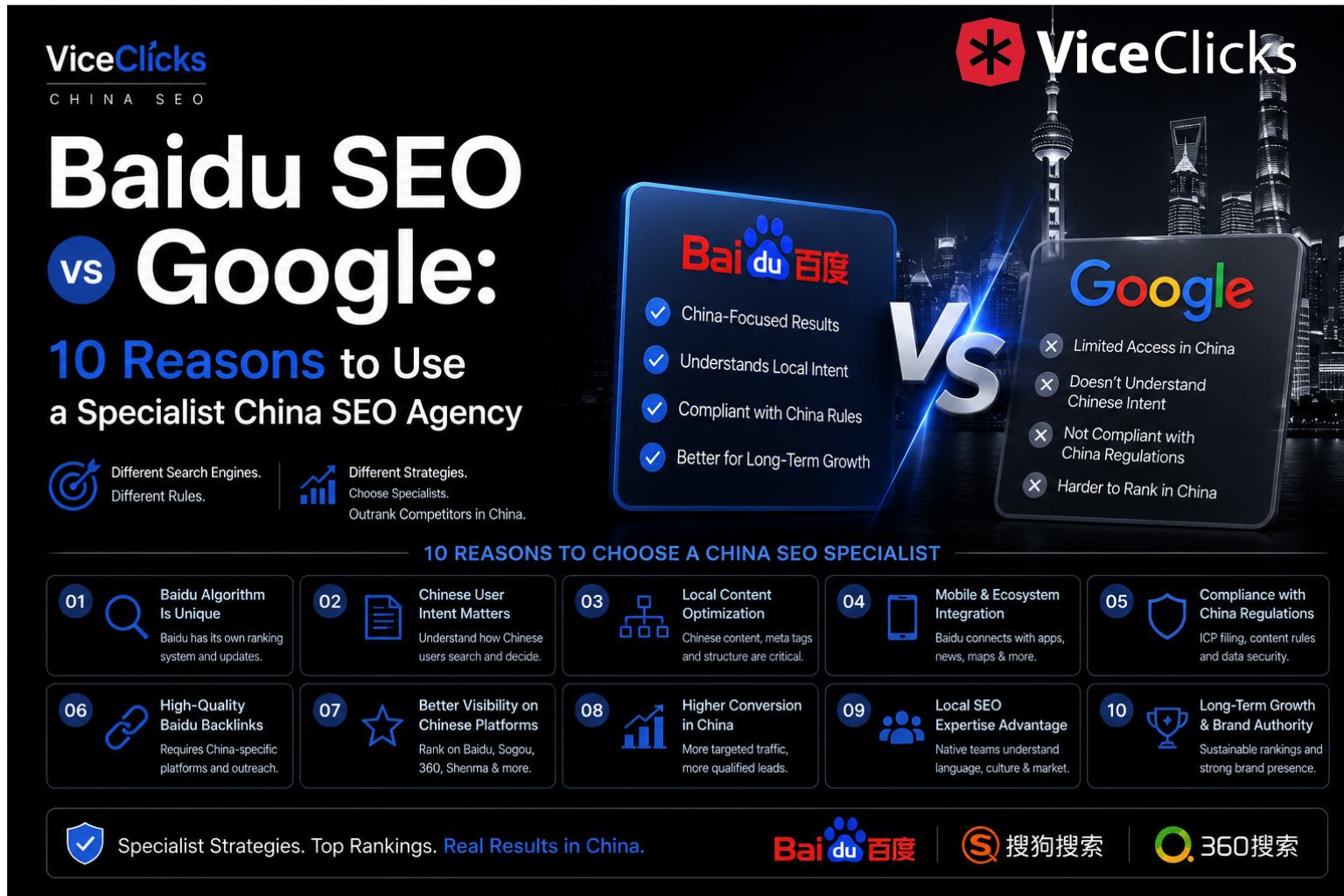
- Baidu SEO vs Google: an overview
- Reason 1: Different search ecosystems and products
- Reason 2: Hosting, ICP and technical environment
- Reason 3: Language, intent and cultural nuance
- Reason 4: Content formats and SERP layout
- Reason 5: Link building and authority in China
- Reason 6: Regulation and compliance (especially for finance)
- Reason 7: Data, analytics and measurement
- Reason 8: Multi‑engine reality (Baidu, Sogou, 360)
- Reason 9: Speed of change and algorithm updates
- Reason 10: Execution complexity and local partnerships
- How a specialist China SEO agency bridges the gap
- Resources
Baidu SEO vs Google: an overview
Google is the default frame of reference for most international SEO teams, but China’s search ecosystem follows a different logic. Baidu dominates Chinese web search, yet users also rely on Sogou and 360, as well as super‑apps like WeChat for discovery. For global brands, this means copying Google tactics into China rarely delivers the expected results.
A specialist China SEO agency understands how Baidu prioritises mobile performance, local hosting, Chinese‑language content, ecosystem signals and compliance, and can align your strategy with those realities instead of generic global best practices.
Reason 1: Different search ecosystems and products
Google’s ecosystem spans products like Search, YouTube, Maps and Discover. Baidu has its own web search, feed experiences and vertical products, plus ecosystem properties such as Baidu Baike and Zhidao. These differences influence how users search and what content surfaces for key queries.
Why this matters
- Different SERP features. Baidu often shows more native components and local content modules than Google, especially for branded and informational queries.
- Ecosystem integration. Presence on Baidu’s own properties (e.g., Baike entries, Zhidao answers) can significantly boost visibility and perceived authority.
- User expectations. Chinese users may rely more on local platforms and in‑SERP answer boxes, which affects how you design content and funnels.
Reason 2: Hosting, ICP and technical environment
Google SEO focuses on crawlability and performance, but does not require specific licences to host content in most countries. In China, hosting choices and legal filings such as ICP can influence both accessibility and trust.
Why this matters
- Latency and hosting. Sites hosted far from China often feel slow for mainland users; Baidu tends to favour fast, locally accessible sites, and other engines follow that pattern.
- ICP filing. For sites hosted in mainland China, an ICP number is a basic requirement, especially for commercial operations; failing to address this can limit growth.
- Infrastructure decisions. CDNs, firewalls and caching rules must be configured with Chinese crawlers and users in mind, which is not something a generic SEO team always understands.
Reason 3: Language, intent and cultural nuance
Google handles multilingual content, but many global SEO programs treat translation as the main step. In China, language and culture shape search intent more deeply, and Baidu strongly prefers native‑quality simplified Chinese content.
Why this matters
- Keyword research. Chinese queries often combine local slang, regulatory concerns and brand nicknames that simple translation misses.
- Intent mapping. Users may ask more detailed “how”, “safe or not” and comparison questions in Chinese, especially for finance and trading topics.
- Trust in language. Poorly localized or obviously machine‑translated copy undermines trust and can reduce engagement even if pages technically rank.
Reason 4: Content formats and SERP layout
Google surfaces a mix of web results, rich snippets and video. Baidu does this too, but its SERPs often highlight different content formats and local verticals, and can be more crowded with native modules.
Why this matters
- Content design. Articles and landing pages built only for Google’s expectations may not align with how Baidu displays information or how Chinese users skim content.
- Local modules. Local maps, Q&A blocks and Baidu‑native panels can dominate screen space; you need a plan to appear in or complement those modules.
- Device distribution. Mobile usage tends to be very high, so page structure and content length must be optimized for mobile SERPs and reading habits.
Reason 5: Link building and authority in China
Google has long relied on backlinks as a key ranking signal. Baidu also uses link signals, but the context differs: local domains, platform presence and editorial relevance matter more than sheer link volume.
Why this matters
- Different link ecosystems. Chinese portals, forums, Q&A sites and social platforms form a distinct link and mention landscape that global link networks don’t cover.
- Risk of spam. Low‑quality link schemes can trigger penalties or devaluation, and some tactics common in other markets are especially risky in China.
- Platform signals. Authority can come from mentions on Chinese portals, Baidu properties and WeChat content, not just conventional backlinks.
Reason 6: Regulation and compliance (especially for finance)
Both Google and Baidu must follow local laws, but many industries are more heavily scrutinized in China. Finance, forex, healthcare, education and gaming face strict content and advertising rules.
Why this matters
- Content limitations. Certain claims, offers or phrasing may be restricted or require careful legal review before publication.
- Moderation risk. Missteps can lead to content removal, downgrades or broader risk to a domain’s visibility.
- Need for specialist oversight. A China SEO agency familiar with your industry can help align SEO, legal and compliance teams, reducing risk while still driving growth.
Reason 7: Data, analytics and measurement
Google Search Console and common analytics tools provide familiar datasets. Baidu and other Chinese engines have their own interfaces and sometimes require different implementation approaches to gather reliable data.
Why this matters
- Different reporting tools. You must learn and manage separate dashboards for Baidu and other engines instead of relying solely on Google’s tools.
- Tracking limitations. Some analytics scripts can be blocked or slowed from mainland IPs, leading to gaps that require alternative approaches.
- ROI visibility. Without proper engine‑level segmentation and event tracking for China, it’s hard to see whether your investment is delivering customers or just clicks.
Reason 8: Multi‑engine reality (Baidu, Sogou, 360)
Google is effectively a single‑engine focus in many countries. In China, Baidu is the largest player, but Sogou and 360 still contribute meaningful organic traffic and have their own quirks.
Why this matters
- Additional engines. An effective China SEO strategy considers Baidu first, but also plans for visibility on Sogou and 360, especially for branded and niche queries.
- Different ranking factors. Sogou’s emphasis on social signals and 360’s focus on security require tailored tactics beyond Baidu’s algorithm.
- Resource allocation. A specialist agency can help decide where to invest effort by engine, rather than treating all Chinese search as one generic channel.
Reason 9: Speed of change and algorithm updates
Google frequently updates its algorithms; Baidu does too, but with different timing, communication and impact. International teams may not track Baidu updates as closely as Google changes.
Why this matters
- Local monitoring. A China‑focused team monitors Baidu changes and local search news, adjusting strategies before issues escalate.
- Recovery priorities. If visibility drops, you need people who understand Baidu’s likely causes and remediation patterns, not just general SEO assumptions.
- Adaptation speed. A specialist agency is structured to respond quickly to algorithm shifts in China without waiting for global guidance.
Reason 10: Execution complexity and local partnerships
Running China SEO from a global head office often involves time‑zone gaps, language barriers and unfamiliar partner networks. Execution complexity increases with every Chinese‑language asset, platform and campaign.
Why this matters
- Coordination overhead. Managing copywriters, PR partners and platform accounts in China from abroad can be slow and error‑prone.
- Local relationships. Established agencies already have relationships with local publishers, portals and communities, reducing friction in outreach.
- On‑the‑ground insight. Specialists bring real‑time insight into user trends, regulatory changes and platform behaviour that global teams may miss.
How a specialist China SEO agency bridges the gap
Given all these differences, using a specialist China SEO agency is less about outsourcing “SEO work” and more about gaining local strategy, execution and risk management. A good partner builds a Baidu‑first plan, adapts it for Sogou and 360, and aligns efforts with your industry’s specific funnel and compliance needs.
What to expect from the right partner
- Engine‑specific strategies. Tailored plans for Baidu plus supporting tactics for Sogou and 360, rather than a copy‑paste of Google methods.
- End‑to‑end support. Help with technical setup, hosting decisions, content localization, link building, analytics and reporting.
- Industry expertise. Experience with similar businesses (finance, trading, gaming, SaaS, ecommerce) so they can design SEO programs that match your funnel and risk profile.
Resources
- ViceClicks China SEO Service — a specialist China SEO and marketing service for finance, forex, gaming, trading and online industries looking to grow through Baidu, Sogou and 360.
- MDN Web Docs — Performance — high‑authority technical guidance on performance best practices that benefit both Google and Baidu SEO.
Closing thoughts
Baidu SEO vs Google is not a simple “copy and paste” difference. The engines, infrastructure, language, regulation and user journeys all diverge enough that international brands benefit from specialist support. By partnering with a dedicated China SEO agency, you can respect local realities, avoid costly missteps and turn Chinese search—from Baidu to Sogou and 360—into a reliable growth channel rather than an experimental side project.